


The Communist Party of China (CPC) has praised the reform and development efforts being undertaken by Ethiopia’s Prosperity Party, as a senior Ethiopian delegation continues a visit to China aimed at strengthening party-to-party relations and sharing development experiences.
The high-level delegation from Ethiopia’s Prosperity Party is being led by Nabiyu Sihul, Director General for Foreign Relations in the People and International Relations sector of the Prosperity Party’s Office. The delegation is in China as part of a programme focused on political dialogue, institutional experience and cooperation between the two ruling parties.
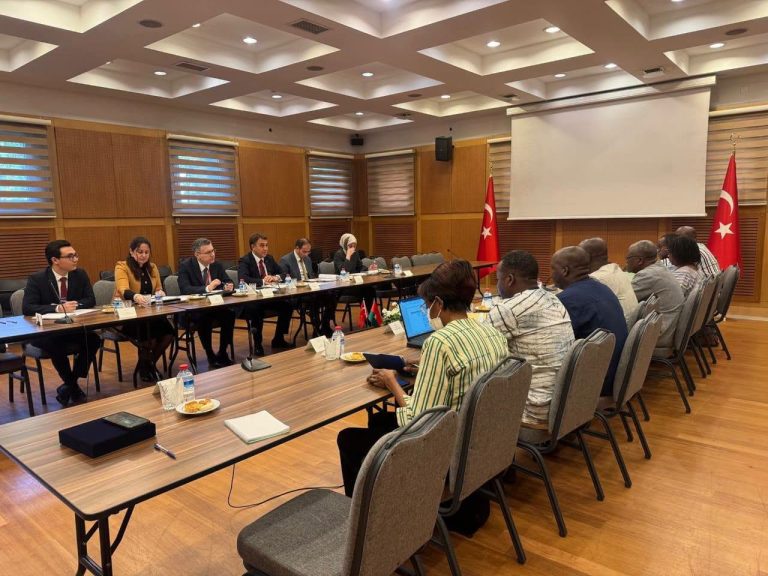
During meetings in Beijing with officials responsible for African affairs within the CPC, the two sides discussed ways of strengthening party-to-party relations and expanding exchanges on governance and development.
Ethiopia Highlights Its Reform Agenda
Speaking during the discussions, Nabiyu Sihul outlined the Prosperity Party’s development philosophy and programmes, emphasizing their role in the economic and social changes currently taking place in Ethiopia.
He highlighted the party’s Medemer philosophy, an approach centered on cooperation, inclusion and the pooling of national resources, as well as several major government initiatives.
Among the areas highlighted were Ethiopia’s Homegrown Economic Reform Agenda, integrated urban and rural development, development programmes aimed at improving citizens’ livelihoods and the country’s Green Legacy Initiative.
According to the Ethiopian delegation, these programmes demonstrate both the policy orientation of the Prosperity Party and its capacity to translate its ideas into concrete development initiatives.
The Green Legacy Initiative, in particular, was presented not only as an environmental and development programme but also as an initiative contributing to Ethiopia’s international diplomatic profile.
Ethiopia to Host African Political Parties Conference
The Ethiopian delegation also pointed to what it described as encouraging developments in the country’s political landscape.
Nabiyu noted that Ethiopia has been selected to host the 2026 Conference of African Political Parties in Addis Ababa, and that preparations are underway for the event.
The planned gathering is expected to provide another platform for political parties from across Africa to exchange experiences and discuss issues affecting the continent.
For Ethiopia, hosting the conference represents an opportunity to strengthen its engagement with African political institutions and further position Addis Ababa as a center for continental political dialogue.
China Expresses Support for Ethiopia’s Transformation
On the Chinese side, Rao Yu Hua, Director General for African Affairs of the Communist Party of China, welcomed the Ethiopian delegation and spoke positively about the changes taking place under the leadership of Prime Minister Abiy Ahmed.
Rao said the CPC and the Chinese government have been following with strong appreciation the transformation being pursued by Ethiopia’s Prosperity Party under the principle of “a strong party for a strong government, and a strong government for a strong country.”
Her remarks reflected Beijing’s interest in deepening political exchanges with Ethiopia, particularly through direct engagement between the two ruling parties.
Rao further reaffirmed the CPC’s commitment to strengthening cooperation with the Prosperity Party and enhancing coordination on issues of mutual interest.
The emphasis on party-to-party relations reflects a distinctive dimension of China’s engagement with African countries, in which political dialogue and the exchange of governance experiences complement diplomatic and economic cooperation.
Learning from China’s Experience
The Ethiopian delegation’s programme in Beijing also included a visit to the Museum of the Communist Party of China, where members of the delegation learned about the history, experience, achievements and challenges of the CPC.
The visit provided the Ethiopian officials with an opportunity to examine how the Chinese Communist Party has drawn lessons from its historical experience while adapting its approach to contemporary challenges and pursuing its long-term development vision.
For the Ethiopian delegation, the museum visit formed part of a broader learning exercise aimed at understanding China’s political and institutional experience.
The exchange is particularly significant as Ethiopia continues to pursue economic reforms, structural transformation and efforts to strengthen state capacity.
Expanding Party-to-Party Cooperation
The visit demonstrates the growing importance attached by both sides to party-to-party engagement as an avenue for sharing experiences and strengthening bilateral relations.
While China and Ethiopia maintain extensive economic and diplomatic ties, exchanges between the CPC and Prosperity Party provide an additional channel for discussing governance, development planning, political organization and institutional capacity.
The two sides are expected to continue their discussions in the coming days, with programmes designed to allow officials from both parties to exchange experiences, learn from one another and explore areas of common interest.
The Ethiopian delegation’s visit comes as both countries seek to deepen their long-standing partnership across political, economic and development fields.
A Dialogue Focused on Development
At the heart of the Beijing discussions is a shared interest in development and governance.
Ethiopia is pursuing an ambitious transformation agenda focused on economic modernization, agricultural and industrial development, urban expansion and environmental initiatives. China, meanwhile, offers decades of experience in economic transformation, infrastructure development and long-term development planning.
The party-to-party dialogue therefore provides a platform for Ethiopia to study aspects of China’s experience while presenting its own reform approaches and development priorities.
The visit also underscores the increasingly multifaceted nature of China-Ethiopia relations, where political exchanges, economic cooperation and development partnerships continue to reinforce one another.
As the Prosperity Party delegation continues its programme in China, the emphasis will remain on experience-sharing, mutual learning and strengthening cooperation between the two parties, with both sides seeking to translate political dialogue into deeper and broader bilateral engagement.
À propos de l'auteur